Which European country used ChatGPT the most in 2025 — and what that means for creators & businesses
In 2025, France led Europe in total ChatGPT traffic—find out which countries followed, why adoption varies across Europe, and how businesses and creators can use this trend to their advantage.
Answer
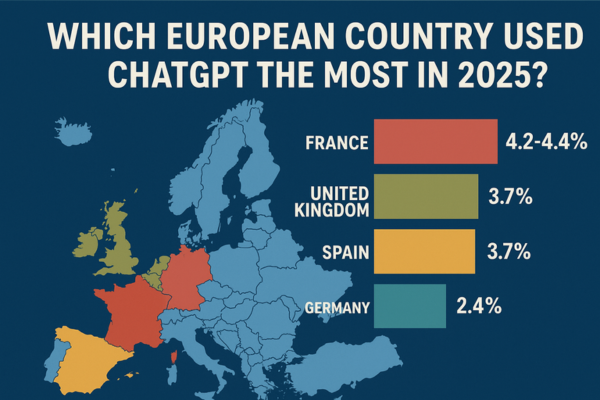
By total traffic share in 2025, France was the largest European market for ChatGPT, with roughly 4.2–4.4% of global ChatGPT visits—ahead of the United Kingdom and Spain (each around ~3.7%) and Germany (about ~2.4%). These figures come from traffic-analyst snapshots and industry reports compiled through 2025.
Why this matters
Knowing which European markets use ChatGPT most helps content creators, SaaS businesses, advertisers, and localizers decide where to prioritize investment: content localization, language support, paid acquisition, and partnerships. France’s leading share in Europe signals a large, engaged user base and strong demand for French-language AI workflows, tools, and learning resources.
Deep dive: data, context and caveats
1. What the numbers actually measure
Most public “who uses ChatGPT the most” lists are built from web-traffic analytics (SimilarWeb-style estimates), Google Trends, and surveys — not from OpenAI user-by-country public disclosures. That means numbers are best interpreted as share of site/portal traffic (visits to chat.openai.com / chatgpt.com) rather than precise monthly active user counts or subscription figures. Use the percentages as relative market-size indicators, not exact headcounts.
2. Europe’s leaderboard (2025 — traffic-share snapshot)
Multiple industry summaries during 2025 consistently put the European top countries roughly like this (order and shares vary a little by source):
-
France: ~4.2–4.4% of global ChatGPT traffic — the largest single European market in 2025.
-
United Kingdom: ~3.6–3.8%.
-
Spain: ~3.7% (similar to the UK in several traffic reports).
-
Germany: ~2.4% (large population but somewhat lower share than France/UK/Spain in web-traffic snapshots).
Different trackers and dates show small shifts (e.g., depending on the month, UK or France may rank first), but the consistent signal through 2025 was: France leading among EU/European countries in total ChatGPT traffic.
3. Per-capita vs total users: the important distinction
Total traffic favors larger markets or those with heavy desktop traffic. However, per-capita AI usage tells a different story: smaller, highly digitalized countries (Nordics, Ireland, the Netherlands) often report higher per-capita AI adoption or regular-use rates. For example, surveys and EU reports in 2025 highlighted Ireland, Norway and France as leaders in frequent AI usage per person — meaning even if a country isn’t the biggest by raw traffic, its population might be more intensely using AI tools.
4. Why France may lead in total European traffic
Several factors likely combine to push France to the top of European ChatGPT traffic-share in 2025:
-
Large, digitally-active population with strong internet penetration.
-
High interest in AI-powered search and productivity among students, professionals, and small businesses.
-
Active French-language content and services that push users toward ChatGPT for writing, research, translation, and learning.
-
Mobile + desktop usage patterns: countries where desktop sessions are common can inflate “visit” metrics (longer sessions, repeat visits).
What creators, marketers and product teams should do with this insight
For content creators and publishers
-
Localize for French audiences: prioritize French-language SEO, tutorials, and how-to pieces for ChatGPT workflows (prompt engineering, prompt libraries, AI for copywriting in French).
-
Target France-focused longtail keywords (e.g., “ChatGPT prompt pour marketing”, “utiliser ChatGPT en français”) and make landing pages optimized for search and shareable on French social channels.
-
Experiment with formats: short explainer videos, downloadable prompt packs, and French-language tutorials tend to convert well in markets with high usage.
For SaaS/product teams
-
Ship French localization early: user interfaces, onboarding flows, and help docs in French will reduce friction and increase adoption.
-
Consider compliance and data residency: European users (and regulators) care about privacy and data handling — be explicit about data policies.
-
Test EU pricing & offers: pricing that reflects local purchasing power and payment preferences increases conversion.
For marketers & advertisers
-
Run targeted campaigns in France and other high-share EU markets — but test both total-reach (France, UK) and per-capita-intensity markets (Ireland, Nordics) for ROI.
-
Partner with local influencers and educators who show real AI workflows — demonstrations and case studies perform better than abstract promises.
(Underlying traffic and regional shares referenced from 2025 traffic analyses and digital reports.)
Limitations & what to monitor in 2026
-
Traffic estimates change fast. Market share snapshots come from different months and tools; new product launches, app-store shifts, or competitors (e.g., Google’s AI products) can rapidly change rankings. Keep an eye on SimilarWeb and DataReportal summaries and official OpenAI disclosures when available.
-
Regional policy changes (EU AI Act enforcement, local restrictions) could affect usage patterns.
-
Per-capita adoption vs total visits: smart strategies combine both metrics — high total traffic signals audience size, while per-capita adoption signals engagement intensity.
If you’re choosing where to focus content, products, or marketing for ChatGPT-related services in Europe in 2025, France is the top market by total traffic share — but don’t ignore the UK, Spain, Germany or the high per-capita adopters (Nordics, Ireland). The smart approach is to balance raw-reach (France, UK, Spain) with intensity (per-capita usage leaders) and to localize content, UX, and pricing accordingly.
FAQ
Q: Is France the “most ChatGPT-friendly” country in Europe by user count?
A: By estimated total web-traffic share in 2025, France was the largest single European market; however “friendliness” can also mean per-capita use or regular daily adoption, where Nordic countries and Ireland often score higher.
Q: Where can I find the raw data?
A: The most commonly referenced datasets come from web-traffic analysts (SimilarWeb-style reports), aggregated industry write-ups (VisualCapitalist, DataReportal), and national surveys on AI usage. Use those sources for monthly snapshots.
Q: Will this change quickly?
A: Yes — adoption and traffic shares are dynamic. New features, local-language models, or apps can shift who leads a region within months. Monitor quarterly traffic reports and Google Trends for early signs of change.