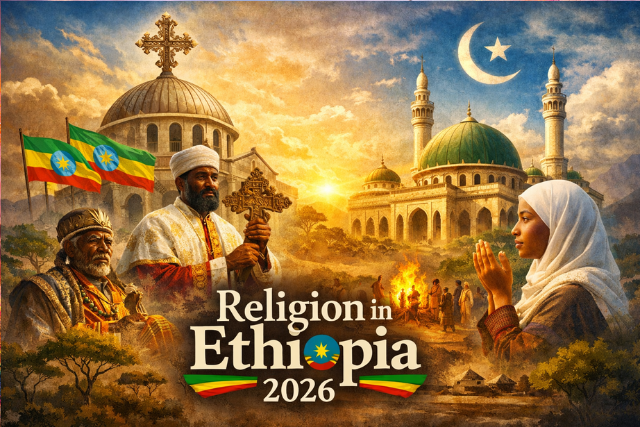
Which Religion is Practiced in Ethiopia in 2026?
A Complete Religious Breakdown with Percentages
Ethiopia stands out as one of the world’s most historically rich and religiously diverse nations. Located in the Horn of Africa, the country has served as a crossroads of faith for more than two millennia. Unlike many countries where religion arrived through colonization, Ethiopia developed its religious traditions independently and very early in global history. As of 2026, religion continues to play a central role in Ethiopian society, shaping culture, law, holidays, family life, and regional identities.
So, which religion is practiced in Ethiopia in 2026, and what are the exact percentages? The answer reflects a balanced coexistence between Christianity and Islam, with smaller but important communities practicing traditional and other faiths.
Overview of Religion in Ethiopia (2026 Snapshot)
Ethiopia does not have an official state religion. Its constitution guarantees freedom of belief, worship, and religious expression. In practice, the population is largely divided between Christianity and Islam, making Ethiopia one of the few countries in the world where these two faiths exist in near demographic balance.
Estimated Religious Composition of Ethiopia in 2026
Based on the most recent national census baseline (2007), updated population growth patterns, and large-scale surveys conducted up to 2024, Ethiopia’s religious makeup in 2026 is estimated as follows:
-
Christianity (Total): ~63%
-
Ethiopian Orthodox Tewahedo Church: ~41%
-
Protestant & Evangelical Churches: ~21%
-
Roman Catholic: ~1%
-
-
Islam (Sunni, majority): ~37%
-
Traditional / Indigenous Beliefs: ~0.5%
-
Other religions & no religious affiliation: ~0.5%
These figures reflect gradual demographic shifts rather than sudden changes, as religious identity in Ethiopia tends to be stable across generations .
Christianity in Ethiopia: The Largest Religious Group
Total Christian Population in 2026
Christianity remains the largest religion in Ethiopia, accounting for roughly 63% of the population in 2026. Ethiopia is globally recognized as one of the first countries to officially adopt Christianity in the 4th century, long before much of Europe.
Christianity in Ethiopia is not a single tradition but a family of churches with deep historical roots and growing modern expressions.
Ethiopian Orthodox Tewahedo Church (≈ 41%)
The Ethiopian Orthodox Tewahedo Church (EOTC) is the oldest and most influential Christian institution in the country. In 2026, it represents approximately 41% of Ethiopia’s total population, making it the single largest religious denomination.
The church traces its origins to the ancient Kingdom of Aksum, where Christianity became the state faith in the 4th century. The EOTC follows a unique Oriental Orthodox theology, distinct from Roman Catholicism and Eastern Orthodoxy.
Key features of the Ethiopian Orthodox Church include:
-
Ancient liturgical language (Ge’ez)
-
Extensive fasting periods throughout the year
-
Strong monastic traditions
-
Important faith-based celebrations include Timkat, which marks Epiphany, and Meskel, the Festival of the True Cross.
The church remains strongest in northern and central regions, including Amhara and Tigray, but also maintains a nationwide presence .
Protestant and Evangelical Christianity (≈ 21%)
Protestant Christianity has grown significantly over the past century and now accounts for approximately 21% of Ethiopia’s population in 2026.
These churches include:
-
Lutheran traditions
-
Pentecostal and charismatic movements
-
Evangelical congregations
Protestant communities are especially prominent in southern and western Ethiopia, including parts of Oromia and the Southern Nations, Nationalities, and Peoples’ Region (SNNPR).
Growth factors behind Protestant expansion include:
-
Strong youth engagement
-
Community-based worship
-
Emphasis on education and social services
Despite rapid growth in earlier decades, Protestant expansion has stabilized in recent years, leading to steady rather than explosive increases by 2026 .
Roman Catholicism (≈ 1%)
Roman Catholics form a small but historically significant minority in Ethiopia, accounting for roughly 1% of the population in 2026.
Catholic communities are concentrated in:
-
Urban centers
-
Southern regions
-
Areas with long-standing missionary activity
Although small in number, Catholic institutions play an important role in healthcare, education, and humanitarian services across the country.
Islam in Ethiopia: A Deeply Rooted Faith (≈ 37%)
Muslim Population in 2026
Islam is the second-largest religion in Ethiopia, practiced by approximately 37% of the population in 2026. Nearly all Ethiopian Muslims follow Sunni Islam, with strong Sufi traditions in many regions.
The presence of Islam in Ethiopia began during the era of Prophet Muhammad. Ethiopia holds a special place in Islamic history because it was the destination of the First Hijra, when early Muslims sought refuge from persecution.
Regional Distribution of Muslims
Muslim communities are especially prominent in:
-
Somali Region
-
Afar Region
-
Eastern and southeastern Oromia
-
Parts of Addis Ababa
Mosques, Islamic schools, and cultural centers are deeply embedded in these regions, contributing to Ethiopia’s pluralistic religious identity.
Despite occasional political tensions, Muslims in Ethiopia have historically coexisted peacefully with Christian communities, sharing markets, neighborhoods, and public life .
Traditional and Indigenous Beliefs (≈ 0.5%)
A very small share of Ethiopia’s population—about 0.5% in 2026—still follows indigenous African belief systems.
These belief systems often involve:
-
Ancestral reverence
-
Nature-based spirituality
-
Ritual practices tied to land and seasons
In many cases, traditional beliefs are blended with Christianity or Islam rather than practiced independently. Over time, urbanization and formal religion have reduced the number of exclusive adherents, but cultural elements remain influential in rural communities .
Other Religions and Non-Religious Population (≈ 0.5%)
A very small segment of Ethiopia’s population practices other religions or identifies with no religion at all. This group includes:
-
Small Jewish (Beta Israel) communities
-
Baha’i followers
-
Individuals who identify as non-religious
Together, these groups make up approximately 0.5% of the population in 2026.
Why Ethiopia’s Religious Percentages Change Slowly
Unlike many countries experiencing rapid secularization, Ethiopia’s religious composition changes at a gradual pace. Several factors explain this stability:
-
Strong family-based religious transmission
-
High cultural value placed on faith
-
Limited religious switching in adulthood
-
Rural population maintaining tradition
Population growth affects all religious communities relatively evenly, which is why percentages remain stable even as absolute numbers increase.
Religion and Daily Life in Ethiopia
Religion in Ethiopia extends far beyond places of worship. It influences:
-
Public holidays
-
Dietary habits
-
Marriage customs
-
Education
-
Community dispute resolution
Major Christian and Islamic holidays are nationally recognized, reflecting the country’s commitment to religious inclusivity.
Ethiopia in Global Religious Context
Globally, Ethiopia ranks among the top countries by number of Christians and Muslims. It stands among the limited number of countries where:
-
Christianity and Islam both have ancient roots
-
Neither religion is dominant enough to marginalize the other
-
Religious coexistence is embedded in national identity
This balance makes Ethiopia a unique case study in religious continuity and pluralism.
Which Religion Is Practiced in Ethiopia in 2026?
In 2026, Ethiopia remains a deeply religious nation defined by historical continuity and diversity:
-
Roughly 63% of the population identifies as Christian, primarily under the Ethiopian Orthodox tradition.
-
Islam is practiced by a substantial minority (~37%) with centuries-old roots.
-
Traditional beliefs and other religions together account for about 1%.
Rather than shifting dramatically, Ethiopia’s religious landscape reflects stability, coexistence, and cultural depth—qualities that have shaped the nation for over 1,600 years.