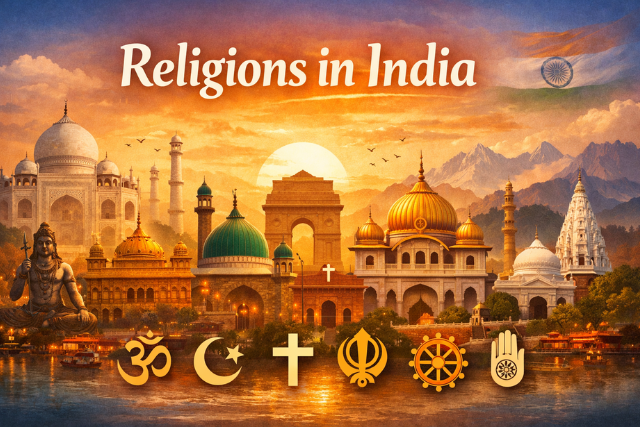
Religions in India in 2025: Complete List With Population Percentages
“Across the world, India is recognized for the remarkable variety of religions and spiritual traditions followed by its people.” With a population exceeding 1.4 billion people in 2025, the country is home to almost every major world religion as well as several faiths that originated on the Indian subcontinent itself. The Indian Constitution guarantees freedom of religion, allowing multiple belief systems to coexist within a single national framework.
This article provides a clear, updated overview of religions in India in 2025, including estimated population percentages, historical background, and social influence.
Religious Landscape of India in 2025 (Overview)
India does not conduct a full religious census every year. Therefore, religious distribution in 2025 is best understood through demographic continuity, fertility trends, migration patterns, and long-term population studies. While small changes occur annually, the overall structure of India’s religious composition remains relatively stable.
Estimated Religious Composition of India in 2025
| Religion | Estimated Percentage (2025) |
|---|---|
| Hinduism | ~79% |
| Islam | ~15% |
| Christianity | ~2.3% |
| Sikhism | ~1.7% |
| Buddhism | ~0.7% |
| Jainism | ~0.4% |
| Other religions | ~0.7% |
| No religion / Not stated | ~0.2% |
These estimates reflect gradual demographic change rather than sudden shifts
Hinduism in India (≈ 79%)
The Largest Religion in the Country
Hinduism remains the dominant religion in India in 2025, followed by roughly four out of five Indians. It is also the world’s oldest continuously practiced religious tradition, with roots stretching back thousands of years.
Key Characteristics
-
No single founder
-
Philosophical diversity (Vedanta, Yoga, Bhakti, Shaivism, Vaishnavism)
-
Its spiritual literature is rooted in ancient writings such as the Vedas and Upanishads, along with legendary narratives including the Mahabharata.
Social and Cultural Influence
Hindu traditions strongly shape Indian festivals, daily rituals, family structures, and national holidays. Major celebrations such as Diwali, Holi, Navratri, and Raksha Bandhan are observed far beyond strictly religious contexts.
Despite a slight proportional decline over decades, Hinduism’s absolute population continues to grow due to India’s overall population increase
Islam in India (≈ 15%)
Second-Largest Religious Community
Islam is the second-largest religion in India and represents one of the largest Muslim populations in the world. In 2025, Muslims account for approximately 15% of India’s population, reflecting steady demographic growth.
Historical Roots
Islam arrived in India over a millennium ago through:
-
Arab traders on the western coast
-
Islamic dynasties in North India
-
Cultural exchange and scholarship
Regional Distribution
Muslim populations are concentrated in states such as:
-
Uttar Pradesh
-
West Bengal
-
Bihar
-
Assam
-
Kerala
Islam plays a major role in India’s linguistic, architectural, and culinary heritage, contributing landmarks such as mosques, mausoleums, and urban centers.
Christianity in India (≈ 2.3%)
A Small but Influential Minority
Christians form roughly 2.3% of India’s population in 2025. Although numerically smaller, the Christian community has a visible presence in education, healthcare, and social services.
Origins and Growth
Christianity reached India in ancient times, traditionally linked to early apostolic missions along the southern coast. Over centuries, different denominations developed, including:
-
Catholic
-
Protestant
-
Orthodox churches
Regional Presence
Christian populations are strongest in:
-
Kerala
-
Goa
-
Nagaland
-
Mizoram
-
Meghalaya
Christian institutions have played a significant role in literacy and higher education across India.
Sikhism in India (≈ 1.7%)
A Religion Born in India
Sikhism originated in the Punjab region in the 15th century and remains deeply rooted in Indian history. In 2025, Sikhs represent approximately 1.7% of the national population.
Core Beliefs
-
Belief in one God
-
Emphasis on equality and service
-
Rejection of caste discrimination
Cultural Identity
The Sikh community is globally recognized for its traditions of:
-
Community kitchens (Langar)
-
Distinct identity symbols
-
Agricultural and military contributions
Punjab remains the spiritual and cultural heartland of Sikhism.
Buddhism in India (≈ 0.7%)
Ancient Roots, Smaller Population
Although Buddhism originated in India, it represents a small percentage (about 0.7%) of the population in 2025.
Revival and Modern Presence
Modern Indian Buddhism includes:
-
Historical Buddhist communities
-
Converts inspired by social reform movements
-
Monastic and cultural institutions
Buddhist populations are concentrated in Maharashtra, Uttar Pradesh, Ladakh, and parts of the Himalayan region.
Jainism in India (≈ 0.4%)
One of the Oldest Living Religions
Jainism, founded in ancient India, accounts for about 0.4% of the population in 2025.
Defining Principles
-
Non-violence (Ahimsa)
-
Asceticism
-
Ethical living
Despite its small size, the Jain community has an outsized impact on commerce, philanthropy, and ethical business traditions.
Other Religions in India (≈ 0.7%)
Indigenous and Global Faiths
India is home to several smaller religious groups, including:
-
Zoroastrianism (Parsis)
-
Judaism
-
Bahá’í Faith
-
Tribal and indigenous belief systems
Though collectively small in number, these communities are legally protected and culturally respected within India’s pluralistic framework.
No Religion / Not Stated (≈ 0.2%)
A very small share of Indians identify as:
-
Non-religious
-
Spiritual but unaffiliated
-
Undeclared
This category remains minimal compared to many Western countries, reflecting India’s deeply rooted spiritual culture.
Which Religion Is on Top in India in 2025?
Hinduism clearly ranks first in India in 2025, both in percentage and total number of followers. It is followed by Islam as the second-largest religion, with all other faiths forming smaller but significant minorities.
Why Religious Diversity Matters in India
India’s religious composition influences:
-
National policies
-
Education systems
-
Cultural expression
-
Festival calendars
-
Social harmony
The country’s ability to sustain religious plurality across centuries is a defining characteristic of its civilization.
In 2025, India remains a multi-religious nation anchored by Hinduism, enriched by Islam, Christianity, Sikhism, Buddhism, Jainism, and numerous smaller traditions. While demographic proportions evolve slowly, India’s commitment to religious freedom continues to shape its global identity.
Understanding the religious structure of India is essential for researchers, travelers, educators, and anyone seeking insight into one of the world’s most complex societies.