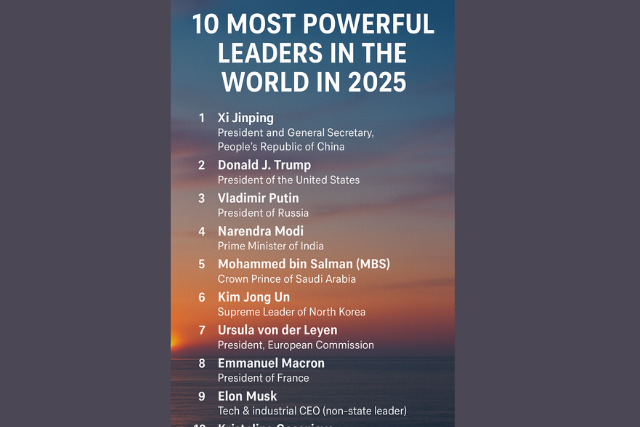
The 10 most powerful leaders in the world in 2025
Discover the 10 most powerful leaders in the world in 2025 — why they matter, what levers of power they hold (military, economic, diplomatic, tech), and how their decisions shape global politics and markets.
Power is messy: it’s not just about the size of an army or a country’s GDP. Today a leader’s clout can come from political authority, control over tech and capital, influence in international institutions, or the strategic energy and food resources their country supplies. Below is an SEO-friendly, up-to-date guide to the 10 most powerful leaders in the world in 2025, selected for the scope of their reach and the levers they control — with short reasons why each ranks among the world’s most consequential decision-makers.
1. Xi Jinping — President and General Secretary, People’s Republic of China
Xi Jinping remains the single most consequential national leader in 2025: he heads the Chinese Communist Party, commands the military as chair of the Central Military Commission, and steers the world’s second-largest economy and the planet’s largest manufacturing base. China’s economic weight, strategic technology initiatives (AI, chips), and shaping of the global supply chain give Xi outsized leverage in diplomacy and geopolitics.
2. Donald J. Trump — President of the United States
The U.S. presidency is often the most powerful office on Earth, and in 2025 the person in that office has decisive influence over global security, trade policy, and the dollar-based financial system. The U.S. also leads major military alliances and technology markets; Washington’s choices about tariffs, alliances, and defense posture ripple globally. (See the official 2025 inauguration and White House materials for the transition and policy tone in 2025.)
3. Vladimir Putin — President of Russia
Russia’s leader continues to wield strong influence through military capability (including nuclear forces), energy exports to global markets, and geopolitical leverage in Europe and the Middle East. The Kremlin’s actions around Ukraine and regional diplomacy keep Putin among the world’s most pivotal—and closely watched—leaders.
4. Narendra Modi — Prime Minister of India
India’s prime minister leads the world’s most populous democracy and the fastest-growing major economy in many metrics. India’s strategic position in Asia, its growing defense spending, expanding tech sector, and diplomatic weight in forums like the G20 and Quad make Modi a critical global actor in 2025.
5. Mohammed bin Salman (MBS) — Crown Prince of Saudi Arabia
Saudi Arabia’s Crown Prince holds real power over the kingdom’s political, economic and energy strategy. As the architect of major economic reforms and custodian of a large share of global oil output, his decisions on oil production, investment, and regional security matter to energy markets and geopolitics alike. In 2025, Saudi diplomacy and energy policy remain central to global stability and markets.
6. Kim Jong Un — Supreme Leader of North Korea
Kim Jong Un’s influence is driven less by economic size and more by nuclear and missile capabilities, the opacity of North Korean decision-making, and the regime’s ability to shape security calculations in Northeast Asia. Even limited escalations or technological advances in Pyongyang can force major policy changes in Seoul, Tokyo and Washington.
7. Ursula von der Leyen — President, European Commission
The European Commission president leads the executive arm of the European Union — a bloc that, as a whole, represents one of the world’s largest economies. Von der Leyen shapes EU trade policy, sanctions regimes, industrial strategy (including green industry and defense investment), and external relations with China, the U.S., and neighbouring regions — giving her substantive global sway in 2025.
8. Emmanuel Macron — President of France
France is a permanent UN Security Council member, a nuclear power with global military reach, and a major diplomatic actor in Europe, Africa and the Middle East. The French president often plays a balancing role between Washington, Beijing and European partners; in 2025 Macron’s diplomacy and defense posture continue to shape European strategic choices.
9. Elon Musk — Tech & industrial CEO (non-state leader)
Power in 2025 isn’t only national. Elon Musk, leading major firms with global reach in electric vehicles, space, satellite internet and AI investments, is an example of a private-sector leader whose decisions affect communications infrastructure, transport, space access and markets worldwide. That economic and technological influence places him among the most powerful non-government actors.
10. Kristalina Georgieva — Managing Director, International Monetary Fund (IMF)
Heads of major international institutions have unique forms of power. The IMF sets global financial norms, lends to countries in crisis, and shapes macroeconomic policy advice. As IMF managing director in 2025, Kristalina Georgieva influences the policy choices of indebted countries, coordinates global financial responses to crises, and helps steer debates on trade, tariffs and economic stability.
Why these 10? — the power levers that matter in 2025
-
Military and nuclear capability: Leaders who command large, modern armed forces and nuclear arsenals (U.S., China, Russia, France, North Korea) can shape deterrence, war, and peace.
-
Economic scale and markets: Countries with large GDPs, big domestic markets, or central roles in supply chains (U.S., China, EU, India) have outsized ability to influence global growth.
-
Energy and commodities: Whoever controls major oil, gas, rare-earth, or grain supplies can move markets and affect smaller economies (Saudi Arabia, Russia).
-
Technology and infrastructure: Private-sector CEOs and state leaders who control key tech sectors (AI, chips, satellites, social platforms) shape communications, commerce, and national security.
-
Multilateral institutions: Heads of the IMF, World Bank, and major blocs (EU) influence norms, lending and crisis response — an important non-territorial power.
These levers rarely act alone. For example, China pairs technological investment with state planning; the United States wields military alliances and capital markets; Saudi energy policy has global economic consequences.
Caveats and methodology
-
Rankings of “power” are inherently subjective. Different outlets (Forbes, Time, academic indices) use different criteria (wealth, formal authority, soft power, institutional control). This article prioritizes practical global influence in 2025 — a mix of political authority, control of resources/markets, and technological and institutional reach.
-
The list blends state leaders (presidents, prime ministers), institutional leaders (IMF), and private-sector leaders (CEOs) because in 2025 power is distributed across both public and private spheres.
-
If you want a different framing (only heads of state, only elected leaders, or a strictly “Forbes-style” ranking), I can reformat this list to match that filter and cite the relevant ranking methodology.
Power in 2025 is diffuse and multi-dimensional. While heads of state like Xi Jinping, Donald Trump, Vladimir Putin and Narendra Modi set high-level policy, a handful of crown princes, institutional chiefs and tech CEOs wield complementary influence that shapes markets, security, and daily life around the world. Use this list as a starting point — and always check direct, authoritative sources for breaking developments about any leader you care about.
FAQs (quick answers)
Q: Is this the same as Forbes’ “Most Powerful People” list?
A: Not exactly. Forbes has its own methodology and list; this article synthesizes multiple signals (military, economic, tech, institutional influence) to create a practical “who matters most” list for 2025. For explicit Forbes lists, see Forbes’ pages on powerful people and billionaires.
Q: Why is Elon Musk on a list with national leaders?
A: Because by 2025 companies control critical infrastructure (satellite internet, social platforms, electric-vehicle fleets) and private decisions can reshape markets, communications and national capabilities — making some CEOs de-facto global actors.
Q: Can the list change quickly?
A: Yes. Elections, coups, deaths, or sudden economic shocks can reshuffle rankings; this article captures the landscape as of 2025 and links to primary sources for each leader so readers can verify details.