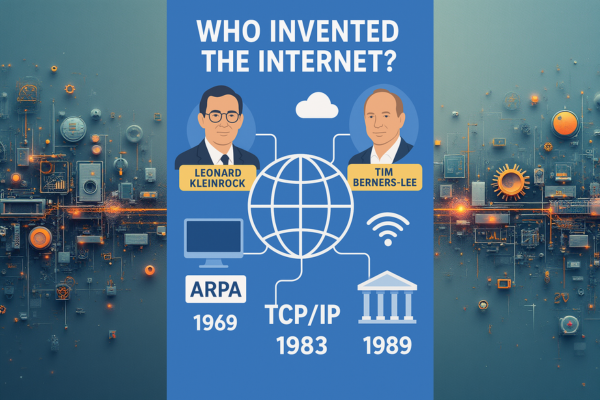
Who Invented the Internet, When, and Where? A Complete History of the World’s Most Important Invention
The internet is the backbone of modern communication, technology, business, entertainment, and global connectivity. Yet very few people truly know who invented the internet, when it began, and where the idea first formed. Contrary to popular belief, the internet was not created by a single person or in a single moment—it evolved over decades, shaped by scientists, researchers, and government programs working across different countries.
This article provides a complete, SEO-friendly, and easy-to-understand history of how the internet was invented, beginning with early ideas from the 1950s and ending with the modern global network we use today.
What Is the Internet?
The internet is a massive global network that connects computers, servers, mobile phones, smart devices, and data centers worldwide. It allows these devices to communicate using a common set of rules called protocols—most importantly TCP/IP. Without these protocols, global communication would not be possible.
Who Invented the Internet?
The internet has multiple inventors, but the key contributors include:
✔ Leonard Kleinrock – Developed the theory of packet switching
✔ Paul Baran & Donald Davies – Invented packet-switching concept independently
✔ ARPA (Advanced Research Projects Agency) – Built the first working network
✔ Vint Cerf & Bob Kahn – Created TCP/IP, the foundation of the modern internet
✔ Tim Berners-Lee – Invented the World Wide Web (WWW) in 1989
While many people helped shape the technology, the first real version of the internet was ARPANET, launched in the United States in 1969.
When Was the Internet Invented?
The foundations were created between 1958 and 1969.
-
The concept began in the late 1950s.
-
The first working network (ARPANET) appeared in 1969.
-
The modern internet officially began on January 1, 1983, when TCP/IP became the global standard.
Where Was the Internet Invented?
The early internet was invented in the United States, mainly at:
-
UCLA (University of California, Los Angeles)
-
Stanford Research Institute (SRI)
-
UC Santa Barbara
-
University of Utah
-
ARPA (a U.S. Department of Defense agency)
These institutions formed the first four-node network of ARPANET in 1969.
Complete History of the Internet
1. The Idea Begins: 1950s
The roots of the internet start in the Cold War era. After the Soviet Union launched Sputnik in 1957, the United States became determined to strengthen its scientific and technological capabilities.
As a result, the U.S. government created:
→ ARPA (Advanced Research Projects Agency) in 1958
Its mission was to develop advanced technology to ensure national security. This agency would later create the first version of the internet.
At the same time, scientists began thinking about new ways to make communication networks more reliable—even during emergencies.
2. Invention of Packet Switching: Early 1960s
Before the internet, communication used “circuit switching,” where a dedicated physical connection was required (like old telephone systems). But this method could be easily disrupted.
Three researchers—working independently—created a breakthrough:
✔ Paul Baran (USA)
✔ Donald Davies (UK)
✔ Leonard Kleinrock (USA)
They invented and mathematically proved the idea of packet switching, which means:
-
Data is broken into small “packets”
-
Each packet travels independently
-
Packets reassemble at the destination
This innovation is the core principle behind all internet communication today.
3. The Birth of ARPANET: 1969
ARPANET was the world’s first large-scale packet-switching network and the direct ancestor of the internet.
First ARPANET Message: October 29, 1969
The first message was sent from:
-
UCLA → Stanford Research Institute
The message they tried to send was “LOGIN”, but the system crashed after sending only the first two letters: “LO”.
This moment is widely celebrated as the birth of networked communication.
By the end of 1969, the first four ARPANET nodes were:
-
UCLA
-
Stanford Research Institute (SRI)
-
UC Santa Barbara
-
University of Utah
This tiny network of four computers would eventually become the global internet.
4. Growth of Networking: 1970s
During the 1970s, more universities, research labs, and government institutions connected to ARPANET.
But there was a problem—different networks used different communication rules. There needed to be a universal way for networks to talk to each other.
This is where two important people came in:
✔ Vint Cerf
✔ Bob Kahn
Together they invented:
TCP/IP (Transmission Control Protocol / Internet Protocol)
This standard protocol allowed different networks to interconnect and function as a unified global system.
5. The Official Birthday of the Modern Internet: 1983
On January 1, 1983, ARPANET switched from its old system to TCP/IP.
This day is known as:
→ The official birth of the modern internet.
Suddenly, all networks using TCP/IP could connect to each other, forming one giant “network of networks.”
6. The World Wide Web (WWW) Is Born: 1989–1991
While the internet existed, it was difficult to use and mostly for scientists. There were no websites, browsers, or links.
In 1989, a British scientist named:
✔ Tim Berners-Lee (CERN, Switzerland)
invented three technologies:
-
HTML – the language of web pages
-
URL – the address system
-
HTTP – the communication protocol for websites
He launched the first website in 1991.
This invention made the internet easy for everyone and marked the beginning of the modern web era.
Detailed Timeline
1958 – ARPA created in the United States
1961–1965 – Packet-switching theory invented
1969 – ARPANET sends first message
1973 – TCP/IP development begins
1983 – TCP/IP becomes standard → modern internet is born
1989 – World Wide Web invented
1991 – First website goes live
1993 – Mosaic browser launches → internet becomes mainstream
2000s–2020s – Broadband, Wi-Fi, mobile internet, fiber, 4G, 5G
Future – Quantum internet, 6G networks, AI-driven connectivity
Why Was the Internet Invented?
The internet was built to solve specific problems:
1. Communication during emergencies
The U.S. needed a network that could still operate even if parts were damaged.
2. Share information between universities
Researchers needed a fast, efficient way to transfer data.
3. Build a decentralized communication system
Packet switching provided this flexibility.
4. Later: Make global information accessible
With the Web, knowledge became open to everyone.
Who Deserves Credit for the Internet? (Full List)
Foundational Thinkers
-
Leonard Kleinrock
-
Paul Baran
-
Donald Davies
Networking Pioneers
-
Vint Cerf
-
Bob Kahn
Infrastructure Creators
-
ARPA and multiple U.S. universities
Web Inventor
-
Tim Berners-Lee
Browser Innovators
-
Marc Andreessen (Mosaic browser)
The internet is the result of international teamwork, decades of research, and thousands of engineers and scientists.
The Internet Is a Global Invention Built Over Decades
No single person invented the internet. Instead, it grew through:
-
Innovative ideas (1950s–1960s)
-
Academic research (1960s–1970s)
-
Standardized communication protocols (1980s)
-
User-friendly web technology (1990s)
Today, the internet connects billions of people, powers global business, and continues to evolve faster than ever. Its invention remains one of humanity’s greatest achievements.
FAQs About the Invention of the Internet
1. Did the U.S. military invent the internet?
Yes, ARPANET was funded by the U.S. Department of Defense.
2. Did Tim Berners-Lee invent the internet?
No, he invented the World Wide Web, which runs on the internet.
3. What was the first message on the internet?
“LO” – an incomplete version of “LOGIN.”
4. What was the first website?
A project info page hosted at CERN in 1991.