Who Was the First Programmer in the World?
One of the most intriguing questions in technology history is who pioneered programming first. Often surprises people, especially those who assume programming began with modern computers. In reality, the roots of programming stretch back nearly two centuries—long before electricity-powered machines existed. The title of the first programmer in history is widely credited to a woman whose work laid the foundation for modern computer science.
who the first programmer was, where she came from, and how programming began, offering a detailed and original historical account designed for readers, students, and technology enthusiasts.
Understanding Programming Before Computers Existed
Before identifying the first programmer, it is essential to understand what programming means in a historical context.
Programming is not limited to writing code in modern languages like Python, Java, or C++. At its core, programming is the act of creating structured instructions that tell a machine how to perform tasks step by step. These instructions can exist on paper, mechanical systems, or symbolic logic.
Long before electronic computers, inventors imagined machines that could follow instructions automatically. This conceptual leap made it possible for the first programmer to emerge.
Who Was the First Programmer?
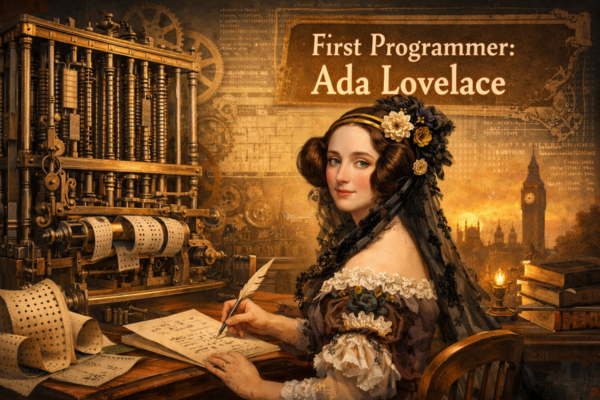
The first programmer in the world was Ada Lovelace.
-
Full Name: Augusta Ada King, Countess of Lovelace
-
Born: December 10, 1815
-
Died: November 27, 1852
-
Nationality: British (England)
-
Place of Origin: London, England
Ada Lovelace is recognized as the world’s first computer programmer because she created the first known algorithm intended to be processed by a machine.
Why Ada Lovelace Is Considered the First Programmer
Ada Lovelace’s achievement was not accidental. She worked closely with English mathematician and inventor Charles Babbage, who designed a mechanical computing device known as the Analytical Engine.
While Babbage designed the machine, Ada Lovelace wrote instructions for it—a crucial distinction.
What Made Her Work Revolutionary?
-
She wrote a step-by-step algorithm
-
The algorithm was intended for a general-purpose computing machine
-
It went beyond pure calculation and included logical operations
-
Her work anticipated modern programming concepts
This makes Ada Lovelace the first person to understand and document how machines could be programmed.
The Analytical Engine: The First Programmable Machine Concept
To understand Ada Lovelace’s role, we must briefly examine the machine she programmed.
What Was the Analytical Engine?
The Analytical Engine was a mechanical computer design proposed in the 1830s. Although never fully built, it included key components found in modern computers:
-
A processing unit (similar to a CPU)
-
A memory system
-
Input and output mechanisms
-
Conditional branching and loops
These features made it the first conceptual general-purpose computer.
Ada Lovelace’s Algorithm Explained Simply
Ada Lovelace wrote an algorithm designed to calculate Bernoulli numbers, a complex mathematical sequence.
While the machine itself was never completed, her algorithm was:
-
Fully structured
-
Logically sound
-
Suitable for execution by a machine
This written algorithm is widely recognized as the first computer program in history.
Where Did Ada Lovelace Come From?
Ada Lovelace was born in London, England, into a unique family background that influenced her intellectual development.
Family Background
-
Her father was Lord Byron, a famous poet
-
Her mother encouraged mathematics and logic to balance poetic tendencies
-
She received private education in mathematics, science, and philosophy
This unusual combination of creativity and logic helped her envision machines as more than calculators.
Ada Lovelace’s Vision of the Future of Programming
What makes Ada Lovelace extraordinary is not just that she wrote the first program—but that she understood the broader potential of computing.
She predicted that machines could one day:
-
Compose music
-
Create graphics
-
Process symbols beyond numbers
-
Assist in scientific discovery
This vision closely resembles modern applications of computers, artificial intelligence, and digital creativity.
Was Ada Lovelace the First Coder or First Programmer?
A common question is whether Ada Lovelace was the first coder or the first programmer.
Key Distinction
-
Coder: Writes instructions using a defined syntax or language
-
Programmer: Designs logical systems and algorithms for machines
Ada Lovelace qualifies as the first programmer, even though modern coding languages did not exist at the time.
Were There Any Programmers Before Ada Lovelace?
Before Ada Lovelace, some systems used instructions, such as:
-
Loom patterns controlled by punch cards
-
Mechanical automata following fixed sequences
However, these systems lacked:
-
General-purpose logic
-
Conditional branching
-
Abstract algorithmic design
Ada Lovelace was the first to combine mathematical reasoning with machine logic, which defines true programming.
Why Ada Lovelace’s Work Was Forgotten for Many Years
Despite her groundbreaking contributions, Ada Lovelace’s work was overlooked for decades.
Reasons for Historical Neglect
-
The Analytical Engine was never built
-
Programming was not recognized as a discipline
-
Gender bias in 19th-century science
-
Her ideas were far ahead of their time
It was only in the 20th century, with the rise of computers, that her work gained recognition.
How Ada Lovelace Influenced Modern Computer Science
Today, Ada Lovelace is celebrated worldwide.
Her Lasting Impact
-
Inspired early computer scientists
-
Influenced algorithmic thinking
-
Proved that machines could manipulate symbols
-
Established the foundation for software development
The Ada programming language, developed in the late 20th century, was named in her honor.
Ada Lovelace vs Charles Babbage: Who Did What?
This question often arises in discussions about early computing.
| Contribution | Ada Lovelace | Charles Babbage |
|---|---|---|
| Machine Design | ❌ | ✅ |
| Algorithm Creation | ✅ | ❌ |
| Programming Concepts | ✅ | ❌ |
| Vision Beyond Math | ✅ | Partial |
Babbage invented the machine, but Ada Lovelace invented programming.
Why the First Programmer Was a Woman
The fact that the first programmer was a woman challenges modern stereotypes.
Ada Lovelace’s story highlights that:
-
Programming began as a mathematical discipline
-
From the earliest days, women made essential contributions.
-
Creativity and logic are equally important in technology
Her contributions have become a global inspiration for women in science, technology, engineering, and mathematics.
Key Events in Ada Lovelace’s Life
-
1815: Born in London, England
-
1833: Met Charles Babbage
-
1843: Published her notes and algorithm
-
1852: Passed away at age 36
-
20th Century: Recognized as the first programmer
Why Ada Lovelace Matters in the Digital Age
In today’s world of artificial intelligence, software engineering, and automation, Ada Lovelace’s ideas feel remarkably modern.
She was the first person to realize that:
Computers are not just calculators—they are tools for creativity and logic.
That single insight defines the entire digital era.
Who Was the First Programmer and Where Was She From?
To summarize:
-
The first programmer in the world was Ada Lovelace
-
She was from London, England
-
She wrote the first algorithm for a machine
-
She laid the foundation for modern programming
Ada Lovelace was not just the first programmer—she was a visionary who understood the future of computing long before the world was ready.
Her work proves that programming is not only about technology but about imagination, structure, and insight.