
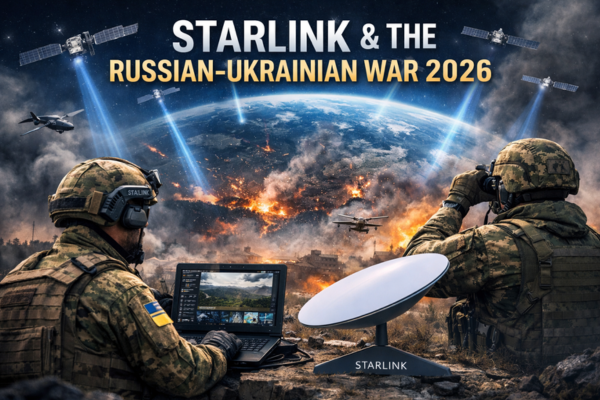
Starlink Updates for the Russian-Ukrainian War 2026
Comprehensive Analysis of Satellite Internet Dynamics in Ongoing Conflict
Introduction
Since its deployment in Ukraine in early 2022, Starlink satellite internet has dramatically shaped how modern warfare is fought. Originally introduced to help maintain internet access across Ukrainian cities and rural areas disrupted by Russian armed attacks, Starlink has evolved into a key instrument of battlefield communications and tactical networking. In 2026, its role is more crucial and controversial than ever — influencing front-line operations, military coordination, and efforts by both sides to adapt to new technological realities.
What Is Starlink and Why It Matters in Warfare
Starlink is a Low-Earth Orbit (LEO) satellite internet constellation developed by SpaceX, designed to bring high-speed, low-latency internet access to remote and underserved areas worldwide. Its capability to bypass ground-based infrastructure (like fiber optics or cellular towers) makes it uniquely valuable during conflicts that disrupt traditional communications.
In Ukraine, Starlink has been used not just for civilian internet access but also for:
-
Command and control communications
-
Coordination of unmanned aerial vehicles (UAVs)
-
Real-time battlefield intelligence sharing
-
Logistics and supply chain management
These functions make it a strategic asset — and a target — in the ongoing war.
Starlink’s Role on the Ukrainian Side
Support for Frontline Communications
Starlink terminals have enabled Ukrainian units to stay connected even in areas where traditional networks are destroyed or jammed. This connectivity has supported:
-
Quick transmission of reconnaissance data
-
Coordination of artillery and troop movements
-
Connectivity for remote command teams
-
Communication with international partners for support
Without reliable communications, commanders on the front line can lose situational awareness — a disadvantage no military wants.
New Verification System
In early February 2026, Ukraine and SpaceX agreed on a mandatory registration and verification system for Starlink terminals in Ukrainian-controlled territory. This “white list” system is meant to ensure that only authorized devices — civilian or military — can access the network. It also minimizes the risk of terminals being hijacked or used illicitly by hostile forces.
This system has introduced some challenges:
-
Ukrainian users without terminal verification have experienced temporary disconnections
-
The process of registering tens of thousands of terminals is slow
-
Priority is given to essential services and military needs
Overall, however, Ukraine sees this shift as necessary to protect the network’s reliability and prevent misuse.
Starlink and the Russian Forces
Initial Use and Controversy
Officially, SpaceX has stated that it does not sell Starlink systems to Russia and that the service is not authorized for use within Russian territory. Despite that, there have been claims from conflict observers and intelligence sources that:
-
Russian units illegally acquired Starlink terminals via third parties
-
Some UAVs and long-range drones were being controlled via Starlink
-
These systems helped bypass traditional anti-jamming measures
The concern grew when Russia allegedly attached Starlink terminals to strike drones to extend their command range and limit jamming by Ukrainian defenses. While these earlier reports are unverified in every case, they helped motivate Ukraine to push for tighter terminal controls.
Starlink Disconnection and Battlefield Impact
In February 2026, SpaceX — at Ukraine’s request — implemented a system that effectively blocked access for unauthorized Starlink terminals used by Russian forces. This disrupted Russian battlefield communication systems, particularly among units relying on satellite internet for:
-
Drone control
-
Real-time data transfer
-
Remote mission coordination
The result, according to battlefield analysts and troop movements reported in February 2026, was that Russian forces experienced disruptions in command and control in areas like Zaporizhzhia, leading to tactical setbacks and allowing Ukrainian forces to reclaim territory.
Some analysts describe this disruption not as a minor glitch but as a significant operational challenge for Russian commanders in contested regions. The loss of consistent satellite communications can hamper decision-making and reduce the effectiveness of coordinated operations.
Frontline Consequences
Ukrainian Advances
Reports from independent assessments and military observers indicate that Ukraine scored notable territorial gains in mid-February 2026, particularly in the Zaporizhzhia region. Some analysts link this advance to the recent interruptions in Russian access to Starlink, suggesting that Russian units struggled to coordinate defenses and maintain supply lines without reliable satellite internet.
While many factors influence any frontline shift — including logistics, manpower, and weather — communications disruptions clearly contributed to Russian disorganization in several areas.
Attempts to Replace Starlink
In response to the blockade, Russian forces have pursued alternatives to maintain connectivity. These include:
-
Deploying tactical Wi-Fi bridges at elevated positions
-
Testing domestic balloon-based communication relays (like 5G balloons)
-
Using legacy satellite and terrestrial networks
Early reports suggest these alternatives are not as effective as Starlink. Balloon systems, for example, can stay aloft for limited days at a time and offer much less bandwidth and reliability.
Additionally, Russian forces sending soldiers to install Wi-Fi bridging systems have reportedly become vulnerable to long-range UAV attacks or ground assaults due to their static placement and predictability.
Broader Technological Implications
Civilian Impact
Starlink’s presence also extends to Ukrainian civilians, many of whom rely on it for internet access in areas where traditional infrastructure has been destroyed or disrupted. This includes:
-
Keeping families connected
-
Enabling distance learning
-
Providing access to news and humanitarian resources
The registration system aims to protect these civilian users by ensuring that rogue terminals aren’t co-opted for military use. However, the process requires education and technical support for users unfamiliar with satellite internet registration procedures.
Russia’s Long-Term Plans for Alternative Networks
In 2026, Russia announced plans to launch its own low-Earth orbit satellite constellation (referred to as “Rassvet”) as an attempt to provide an alternative to Starlink. However, experts are skeptical about whether such a system can be operational and competitive in the near term — especially during wartime constraints. The projected number of satellites and timeline suggest a much smaller network compared to Starlink’s tens of thousands of active spacecraft, making it less capable of replacing global connectivity solutions.
Strategic Consequences and Future Outlook
Evolving Nature of Modern Warfare
The 2026 conflict highlights a broader truth: modern wars are as much digital and informational as they are physical. Battlefield communications, secure networks, and data links are now as crucial as artillery and armor. Controlling or disrupting these systems can have real effects on ground operations.
In this environment, disconnections like the one affecting Russian forces — whether caused by policy decisions, technological blocks, or targeted network controls — can tilt tactical situations.
Civil-Military Integration
Starlink in Ukraine bridges the civilian and military spheres. A technology intended for universal internet access becomes a dual-use system in wartime, blurring lines between humanitarian support and military advantage. This raises questions about:
-
Liability and regulation
-
How companies decide access policies in war zones
-
The ethics of global internet providers intervening in conflicts
These issues will shape policymaking, international law, and corporate responsibility in future conflicts.
In 2026, Starlink remains a pivotal part of the Russian-Ukrainian War, shaping battlefield communications, strategic decision-making, and even territorial movements. From supporting Ukraine’s defense networks to providing unintended access to hostile actors, its presence underscores how modern warfare now intersects with civilian technology and global internet infrastructure.
Ukraine’s efforts to regulate and protect Starlink access — including terminal registration systems — are attempts to ensure the network serves legitimate users while denying its benefits to adversaries. Meanwhile, Russia’s scramble to find replacements — from Wi-Fi bridges to balloon-based relays — highlights a broader tactical challenge when critical communication assets are disrupted.
As this conflict continues, developments in satellite internet and battlefield networking will remain a key indicator of technological advantage and adaptability — for both militaries and civilian communities caught in the crossfire.