
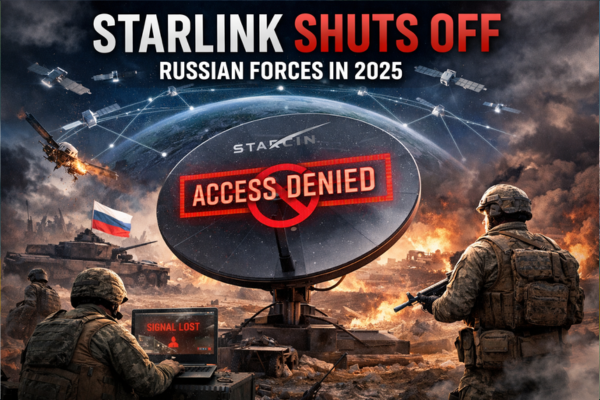
SpaceX’s satellite internet network Starlink shut down for the Russian Army
In one of the most dramatic developments of the Russia–Ukraine conflict, SpaceX’s satellite internet network Starlink restricted access for Russian military forces in 2025, significantly affecting their battlefield communications and tactical operations. This move reshaped how modern warfare is fought, particularly in information-dominant theaters like Ukraine’s front lines.
What Is Starlink?
Before diving into the 2025 event, it’s essential to understand what Starlink is and why it became relevant in a major international conflict.
Starlink is a satellite internet service launched by SpaceX, the private space company led by Elon Musk. Instead of relying on terrestrial infrastructure like fiber optics or cables, Starlink uses a constellation of low-Earth-orbit satellites to provide high-speed internet anywhere on the globe. Initially designed for consumers and underserved rural areas, Starlink eventually found its way into military use because of its reliability and resilience compared to traditional communication networks.
The service operates in over 155 countries and serves millions of users worldwide for everyday communications, business connections, disaster relief and — in conflict zones — tactical battlefield connectivity.
How Russian Forces Used Starlink Before 2025
Although Starlink does not officially provide service in Russia due to regulatory and political limitations, Russian military units in Ukraine managed to access the network through devices smuggled or brought unofficially into conflict zones. These terminals, often purchased abroad and transported by private individuals or intermediaries, allowed Russian units to:
-
Coordinate tactical strike operations
-
Control unmanned aerial vehicles (drones)
-
Transmit battlefield intelligence
-
Improve communication reliability where radio and cellular were jammed or unavailable
Because conventional Russian military communications struggled under electronic warfare conditions and terrain obstacles, Starlink became the backbone of frontline networked operations despite not being sanctioned for such use.
The 2025 Shutdown: What Happened?
In mid-2025 and early 2026, reports emerged that SpaceX had begun blocking unauthorized Starlink connections used by Russian units operating in Ukraine. This was not a complete shutdown of all Starlink services globally, but a deliberate technical move to restrict illicit access by Russian troops. The restrictions were implemented using enhanced verification protocols (like terminal whitelisting), allowing only approved — typically Ukrainian-registered — devices to connect reliably.
According to international military analysts and officials, this decision came after Ukrainian authorities notified SpaceX that Russian forces were using terminals for offensive operations — including drone strikes and coordinated attacks — which violated SpaceX’s terms of service. The company responded by implementing stricter authentication methods that effectively cut off many Russian access points near the frontline.
Importantly, the action was not a unilateral national government decision but stemmed from SpaceX’s enforcement of its own service policies when devices were used in unauthorized military applications.
Immediate Effects on the Battlefield
When Russian units began losing access to Starlink’s satellite internet, the consequences were profound:
1. Disruption of Command and Control
Russian frontline units previously relying on real-time data feeds and high-speed connectivity suddenly faced slower, less reliable communications. Without Starlink, unit commanders struggled to coordinate movements, direct fire, or share critical intelligence in fast-moving engagements.
2. Drone Coordination and Strike Disruption
Advanced drones — whether fixed-wing or quadcopter surveillance models — require steady communication links for real-time navigation and data relay. With Starlink cut off, Russian drone operations slowed significantly or halted in some sectors. This disrupted aerial reconnaissance and strike coordination.
3. Tactical Confusion and Disorganization
Military analysts noted that without reliable satellite connections, Russian infantry and mechanized units struggled to know their own positions relative to friendly forces. In some cases, this led to friendly-fire incidents and poor synchronization between units.
Consequences for the Russia–Ukraine War
The loss of Starlink access for Russian forces had several ripple effects on the broader war:
Ukrainian Advances in Multiple Regions
After Russian units lost reliable satellite connectivity, Ukrainian forces reportedly made meaningful territorial advances, particularly in southeastern directions like Zaporizhzhia and the Dnipropetrovsk front. Analysts attribute part of these gains to the disruption of Russian command systems, giving Ukrainian units better chances to exploit coordination breakdowns.
Strategic Setbacks for Russian Operations
With battlefield communications degraded, the Russian military’s ability to plan and execute coordinated assaults became limited. This loss of operational tempo often forces armies to adopt slower, more defensive postures — putting additional pressure on morale and long-term campaign planning.
Search for Alternatives
After the cutoff, Russian command structures began seeking alternative systems to restore satellite communication capabilities. However, no alternative has matched Starlink in terms of latency, speed, and reliability. Military commentators estimate any viable replacement could take months or years to develop and deploy.
Why Was Starlink So Important?
In modern combat, data connectivity is as strategic as weapons and armor. A loss in communication can result in:
-
Reductions in troop coordination
-
Delays in artillery range adjustments
-
Loss of shared battlefield awareness
-
Decreases in effectiveness of unmanned platforms
Starlink’s mesh of satellites provided a digital backbone that was resilient to ground-based jamming and infrastructure damage — a reason why both Ukrainian forces (officially) and Russian units (illicitly) valued its connectivity.
This episode marked one of the first times a commercial communications system influenced military capabilities at such scale in an ongoing conflict.
Legal and Ethical Considerations
Starlink’s role in the conflict raises complex questions:
Terms of Service
SpaceX’s user agreement generally prohibits military use in unauthorized countries or for combat operations. The company’s enforcement of these terms — even at the cost of affecting battlefield dynamics — reflects its position as a private enterprise controlling critical infrastructure.
Sovereignty and Technology Control
Some argue that external control over battlefield communications by a private U.S. company highlights the power of tech giants and foreign influence in international conflicts. Others counter that enforcing terms to prevent unlawful or non-commercial use is standard in high-risk environments.
These debates are likely to shape future rules about private infrastructure used in military contexts.
Long-Term Implications
Satellite Networks as Strategic Assets
The 2025 Starlink event may set a precedent: commercial satellite constellations can be strategic assets, not just consumer services. Governments and militaries worldwide may accelerate investments in sovereign satellite systems to ensure uninterrupted access during crises.
Development of National Communication Systems
Countries engaged in or observing modern conflicts realize the vulnerability of relying wholly on foreign infrastructure. This may spur the development of dedicated military satellite networks or secure tactical communication platforms that reduce dependency on external providers.
The Starlink shutdown of access for Russian forces in 2025–26 was not a simple shutdown of service, but a strategic enforcement of SpaceX’s service terms in a high-stakes environment. This technical move had tangible military consequences, disrupting Russian battlefield communications and providing a tactical advantage to Ukrainian forces, in some cases facilitating territorial gains.
While the broader effects of this action continue to unfold across multiple fronts, one clear takeaway is that commercial satellite internet has become a pivotal factor in modern warfare — one that both governments and private companies are struggling to navigate responsibly.