
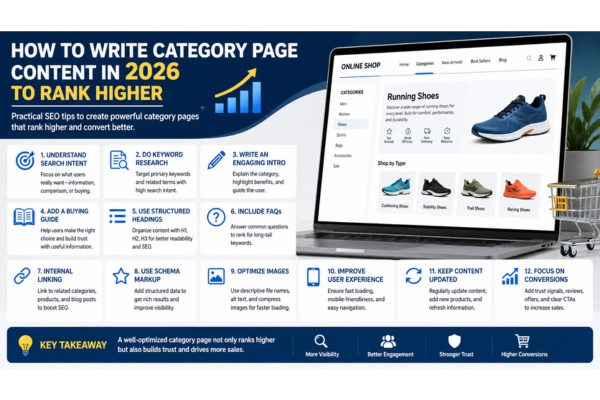
How to write Category Page Content for an Online Shop to Rank Higher in 2026 (Guide)
Category pages are no longer just “product folders” in modern SEO. In 2026, they are powerful landing pages that can drive organic traffic, build topical authority, and convert visitors into buyers. Search engines now understand context, intent, and entities far better than before, so category content must be written strategically—not just stuffed with keywords.
If you run an online shop, mastering category page SEO can be the difference between being invisible and dominating search results.
Below is a complete guide on how to write high-ranking category page content in 2026.
1. Understand the Real Purpose of a Category Page
Before writing anything, you need clarity on what a category page is supposed to do.
A modern category page has three core purposes:
- Help users quickly understand what products are inside the category
- Guide users toward the right subcategories or products
- Signal to search engines the topical relevance of your store
In 2026, Google and AI-driven search systems evaluate category pages as “topic hubs,” not just product listings. That means your page must demonstrate expertise and structure around a subject, not just list items.
For example, a category like “Running Shoes” should also explain types of running shoes, use cases, materials, and buyer considerations—not just display products.
2. Focus on Search Intent, Not Just Keywords
Keyword stuffing is completely outdated. Modern SEO is built on search intent.
There are usually four types of intent:
- Informational (learning about a product category)
- Commercial (comparing options before buying)
- Transactional (ready to purchase)
- Navigational (looking for a specific brand or product line)
A strong category page in 2026 must target commercial intent first, while supporting informational intent.
For example, someone searching “leather jackets for men” may want:
- Styles (biker, bomber, slim fit)
- Material quality
- Price ranges
- Brand comparisons
So your category content should answer these needs naturally within the page.
3. Build Semantic Depth Using Topic Clusters
Search engines now rely heavily on semantic understanding. That means your category page should not exist alone—it should connect to related content.
You should build:
- Subcategories (e.g., Winter Jackets, Summer Jackets)
- Blog posts (e.g., “How to choose a leather jacket size”)
- Product guides (e.g., “Best leather jackets under $200”)
This creates a topic cluster, which improves your authority in that niche.
A category page with strong internal links becomes a central hub, helping Google understand your site structure and expertise.
4. Write an Engaging Intro (But Keep It Useful)
Your category introduction is not decoration—it is SEO real estate.
A strong intro should:
- Explain what the category includes
- Highlight key benefits
- Mention variations or types
- Naturally include primary keywords
- Speak in a human, helpful tone
Example structure:
Instead of writing:
“Welcome to our shoe category. We sell shoes.”
Write:
“This category features a wide range of running shoes designed for comfort, performance, and durability. Whether you’re a beginner jogger or a professional athlete, you’ll find options that match your training style, foot support needs, and budget.”
This improves both SEO and user engagement.
5. Use Structured Headings for Better Crawling
Search engines in 2026 rely heavily on structure.
Your category page should include:
- H1: Category name
- H2: Overview of products
- H2: Types or subcategories
- H2: Buying guide section
- H2: FAQs
This structure helps AI search systems extract clear answers from your page.
Avoid writing long unbroken paragraphs. Instead, organize content logically so both users and search engines can scan it easily.
6. Add a Helpful Buying Guide Section
One of the most powerful SEO strategies for category pages is adding a mini buying guide.
This section should answer real customer questions such as:
- What should I look for before buying?
- What features matter most?
- How do different products compare?
- What price range is reasonable?
For example, in a “Smart Watches” category, you could explain:
- Battery life differences
- Fitness tracking accuracy
- Display types
- Compatibility with phones
This boosts E-E-A-T (Experience, Expertise, Authoritativeness, Trustworthiness), which is critical in modern ranking systems.
7. Optimize for AI Search and Featured Answers
In 2026, search engines don’t just show links—they generate answers using AI.
To appear in AI summaries and featured snippets, your category page should:
- Answer common questions directly
- Use simple, clear language
- Include short definition-style paragraphs
- Provide comparisons and structured explanations
For example:
“Winter jackets are insulated outerwear designed to retain body heat in cold temperatures. They are typically made with down, synthetic fibers, or fleece lining.”
Such sentences are more likely to be extracted by AI systems.
8. Use Natural Keyword Placement (Not Repetition)
Keywords are still important, but they must be used naturally.
Instead of repeating:
Purchase high-quality running footwear online and explore top-rated options for performance and comfort.
You should:
- Use the keyword in the title
- Include it once or twice in the introduction
- Use variations and synonyms throughout the page
For example:
- jogging shoes
- athletic footwear
- performance sneakers
Search engines now understand meaning, not repetition.
9. Improve UX Signals (Very Important for Rankings)
User experience is a major ranking factor in 2026.
Your category page should be:
- Fast loading
- Mobile-friendly
- Easy to navigate
- Visually clean
- Free of clutter
Important UX elements include:
- Filters (size, color, price)
- Sorting options
- Clear product images
- Sticky navigation on mobile
If users stay longer and interact more, your rankings improve naturally.
10. Add Internal Links Strategically
Internal linking is one of the strongest SEO signals for category pages.
You should link to:
- Related categories
- Blog posts
- Product pages
- Guides and comparisons
Example:
From “Men’s Jackets,” link to:
- “Winter Jackets Collection”
- “How to choose jacket size guide”
- “Best waterproof jackets”
This builds a strong internal SEO ecosystem.
11. Use Schema Markup for Rich Results
In 2026, structured data is essential.
Category pages should include:
- Product schema
- Breadcrumb schema
- Organization schema
- FAQ schema
This helps search engines display:
- Ratings
- Prices
- Availability
- Product highlights
Rich results increase visibility and click-through rates significantly.
12. Write FAQs That Match Real Searches
FAQ sections are extremely valuable for SEO.
They help:
- Target long-tail keywords
- Improve AI snippet chances
- Increase page relevance
Good FAQ examples:
- “What is the best type of running shoe for beginners?”
- “How do I choose the right size?”
- “Are expensive shoes better for running?”
Each answer should be short, clear, and informative.
13. Optimize Images and Product Presentation
Category pages are visual-first in eCommerce.
To improve SEO:
- Use descriptive image alt text
- Compress images for speed
- Use consistent image style
- Show multiple angles when possible
Example alt text:
“black leather men’s jacket front view slim fit”
This helps both accessibility and image search rankings.
14. Keep Content Updated Regularly
SEO in 2026 is dynamic. Category pages must evolve.
You should regularly:
- Add new products
- Update descriptions
- Refresh buying guides
- Improve internal links
Google prefers fresh, updated content that reflects current trends and inventory.
15. Focus on Conversion as Much as Ranking
Ranking is only half the goal. Category pages must also convert visitors into customers.
To improve conversions:
- Add trust badges
- Show reviews
- Highlight best sellers
- Use clear “Add to Cart” buttons
- Display discounts or offers
A high-ranking page that doesn’t convert is still a failure in eCommerce SEO.
Writing category page content in 2026 is no longer about stuffing keywords or writing basic descriptions. It is about building structured, helpful, and intent-driven content that satisfies both users and AI-powered search engines.
A high-ranking category page must:
- Understand search intent deeply
- Provide meaningful information
- Use semantic SEO and topic clusters
- Be fast, structured, and user-friendly
- Support conversions as well as rankings
If you combine SEO strategy with real user value, your category pages can become some of the strongest traffic drivers in your entire online store.