
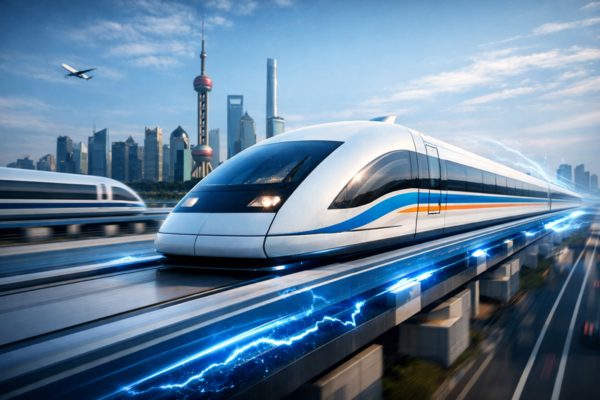
Magnetic Levitation Train Technology, History & Countries Using It
Maglev trains are one of the most exciting innovations in modern transportation. Short for magnetic levitation train, a maglev is a high-speed rail system that uses magnets instead of wheels on rails. These trains can float above the track, travel at extremely high speeds, and offer a smoother and quieter ride than conventional trains.
In this complete guide, you’ll learn:
– What a maglev train is
– How maglev technology works
– Who invented it first
– Where maglev trains are used today
– Pros and cons of maglev systems
– The future of magnetic levitation transportation
1. What Is a Maglev Train?
A maglev (magnetic levitation) train is a type of train that floats above its track using powerful magnets. Instead of wheels and rails like traditional trains, maglev trains are suspended in the air by magnetic forces. Because there’s no direct contact between the train and the track, friction is greatly reduced. This allows maglev trains to travel faster and more efficiently than conventional rail systems.
Unlike regular trains that use steel wheels on steel rails, maglev trains rely on magnetic attraction and repulsion — similar to how magnets can push away or pull toward each other.
Key features of maglev trains include:
-
Floating above the track
-
No touching wheels
-
Reduced friction
-
Very high speeds
-
Quiet and smooth movement
2. How Do Maglev Trains Work?
At the heart of maglev technology are magnetic fields. Magnets can both attract and repel. Maglev trains use this principle to lift, guide, and propel themselves:
Magnetic Levitation (Floating)
Layers of magnets are built into the track and the train. These magnets create forces that:
– Lift the train above the guideway
– Keep it centered over the track
Because the train doesn’t physically touch the track, there’s almost no friction. This allows for higher speeds and less wear and tear.
Magnetic Propulsion (Movement)
Maglev trains use electromagnets — magnets whose strength can be controlled with electricity. These change polarity hundreds of times per second to create a “pulling forward” motion. This system functions somewhat like:
– The track pulls the train forward through magnetic forces.
– The train “surfs” along without contact.
This creates:
– Smooth acceleration
– Fast braking
– Very high top speeds
3. Types of Maglev Technology
There are two main approaches to magnetic levitation used in maglev trains:
1. Electromagnetic Suspension (EMS)
-
Uses electromagnets under the train and above the guideway.
-
Train wraps around the track.
-
Magnets pull upward to lift and stabilize it.
-
Used in some existing maglev systems.
2. Electrodynamic Suspension (EDS)
-
Uses superconducting magnets.
-
Train levitates due to magnetic repulsion.
-
Works at higher speeds.
-
Requires advanced cooling systems.
Both systems achieve levitation, but they differ in how magnets interact to keep the train in the air.
4. Speed: How Fast Can a Maglev Train Go?
One of the biggest advantages of maglev trains is their speed. Because friction is almost eliminated, they can travel much faster than conventional rail.
Typical operating speeds for maglev trains:
– 300–600 km/h (186–373 mph) in regular service
– Test runs exceeding 600 km/h (373 mph)
For comparison:
– Many commercial airplanes cruise at about 900 km/h (559 mph)
– Fastest traditional trains reach around 320 km/h (200 mph)
This means maglev trains rival airplanes for speed over short to medium distances — but with faster boarding and less turbulence.
5. Who Invented the Maglev Train First?
Maglev technology wasn’t invented by a single person in one moment. It evolved over decades, with contributions from scientists in different countries. However, the first practical concept and prototype were created in the mid-20th century.
Early Concepts
In the early 1900s, scientists experimented with magnetic levitation ideas, but the technology and materials didn’t yet exist to make it practical.
Modern Development
Modern maglev research began in earnest after World War II. Two countries played major early roles:
Germany
Engineers in Germany developed some of the earliest maglev designs in the 1960s and 1970s. They built working test tracks and laid foundational research.
Japan
In the 1970s and 1980s, Japanese engineers also began developing maglev technology and built large test facilities.
First Working Maglev System
The first commercial maglev system opened in 1984 in Birmingham, United Kingdom. It was a short demonstration line used at an airport.
So while many researchers contributed to the idea, the first working public maglev train was built and operated in the UK. This was the moment magnetic levitation moved from theory and lab tests into real-world use.
6. Countries Using Maglev Trains Today
Maglev trains are still rare compared to traditional trains because they require unique track infrastructure and advanced technology. But several countries have built operational maglev systems or are in the process of building them.
Japan
Japan is one of the leaders in maglev technology.
– The SCMAGLEV (Superconducting Maglev) line is being built to connect major cities.
– Japan’s maglev has achieved world-record speeds in tests.
Japan plans to use maglev for high-speed passenger travel between Tokyo, Nagoya, and Osaka.
China
China currently has the most extensive maglev network in operation:
– Shanghai Maglev Train
This is the world’s first commercial high-speed maglev. It connects Shanghai’s city center with the airport. It regularly reaches speeds of around 430 km/h (267 mph).
China is also building additional maglev lines in other regions as part of its modern transportation goals.
Germany
Germany continues maglev research and has built test tracks. While large public systems are not widely in use yet, several proposals and experimental projects exist.
South Korea
South Korea has smaller urban maglev lines connecting cities and transportation hubs.
Other Countries
Several nations — including the United States — have considered maglev projects, but none are currently in large-scale operation.
7. Maglev Trains Compared to Traditional Trains
| Feature | Maglev Trains | Traditional Trains |
|---|---|---|
| Contact with track | No (levitates) | Yes (wheels on rails) |
| Friction | Very low | Higher |
| Maximum speed | Higher | Lower |
| Maintenance cost | Lower for wheels/track wear | Higher |
| Infrastructure cost | Very high | Moderate |
| Noise | Low | Higher |
| Ride smoothness | Very smooth | Varies |
Key Differences Explained:
– Friction: Maglev trains don’t touch the track, so there’s almost no friction.
– Speed: Maglev can go much faster because of this lack of friction.
– Maintenance: No physical contact means less wear and tear on wheels and tracks.
– Cost: Building maglev infrastructure is expensive compared to regular rail.
8. Advantages of Maglev Trains
Maglev trains have several benefits over regular rail systems:
1. Ultra-High Speed
Maglev trains can exceed speeds that traditional trains struggle to reach. This makes them ideal for connecting large cities quickly.
2. Smooth Ride Quality
Since there’s no physical contact, the ride is exceptionally smooth — almost like floating.
3. Less Noise
Maglev trains are significantly quieter than high-speed steel-wheel trains, especially at high speeds.
4. Lower Wear and Tear
No wheels grinding on rails means less mechanical wear, which can reduce long-term maintenance.
5. Quick Acceleration & Braking
Magnetic systems allow trains to speed up and slow down quickly and safely.
9. Challenges and Disadvantages
Even though maglev technology is futuristic and efficient, it has challenges:
1. High Cost
Building maglev tracks and infrastructure is very expensive. This makes it hard for many countries to invest.
2. Limited Networks
There are only a few maglev lines globally. Most rail systems still use traditional technology.
3. Specialized Tracks
Maglev trains cannot run on regular rail tracks. They require completely separate magnetic guideways.
4. Electricity Usage
Maglev technology relies on powerful electromagnets and superconductors, which can consume a lot of electricity.
10. How Maglev Trains Help the Environment
Maglev trains are considered more environmentally friendly compared to other transportation options:
Lower energy loss due to reduced friction
Less noise pollution
Potential to use clean electricity (like solar or wind)
Reduced air pollution compared to cars and planes
When powered by renewable energy, maglev systems can be a clean and sustainable travel method.
11. Maglev vs. Bullet Train
People often confuse maglev trains with bullet trains. Though both are high-speed, they are different:
Maglev Train
– Uses magnetic levitation
– Floats above the track
– Faster
– Different track design
Bullet Train
– Uses wheels on rails
– Traditional high-speed rail
– Slightly slower than maglev
– Standard tracks
Both are fast, but maglev takes speed to another level by reducing physical friction.
12. Is Maglev the Future of Transportation?
Many experts believeMaglev trains could play a big role in future travel because:
-
They offer high speed and efficiency
-
They are quiet and smooth
-
They are ideal for densely populated regions
-
They can reduce reliance on air travel for short distances
However, the high cost of building maglev tracks is still a major barrier. As technology evolves and costs decrease, maglev could become more widespread.
13. Real-World Maglev Examples
– Shanghai Maglev Train (China)
-
Connects city to airport
-
Speeds over 400 km/h
-
First commercial high-speed maglev
– Japan’s SCMAGLEV
-
Still expanding
-
Designed for super-high-speed travel
-
Test runs broke speed records
– Urban Maglev Systems
In some countries, smaller maglev systems operate within cities or connect nearby towns.
14. Summary — What You Should Remember
Maglev trains are a revolutionary transportation technology that uses powerful magnets to float above tracks and travel at high speeds. They were first developed through research in countries like Germany and Japan, with the first commercial system opening in the UK in the 1980s. Today, maglev trains are used in countries such as China and Japan, offering unmatched speed and ride quality. While there are challenges like high costs, maglev systems represent a major step toward the future of fast, efficient, and sustainable travel.