
How to Write High-Ranking Blog Content in 2026?
In today’s digital world, blogging remains one of the most powerful ways to share ideas, build authority, and attract organic traffic. Whether you run a personal website, an eCommerce store, or a business platform, understanding what a blog post is—and how to write one that ranks higher in search engines—is essential for long-term success.
This comprehensive guide will explain what a blog post is, why it matters, and how you can craft high-quality, SEO-optimized blog posts that perform well in search results while engaging readers.
What Is a Blog Post?
A blog post is a piece of written content published on a website’s blog section. It typically focuses on a specific topic, question, or problem and aims to inform, educate, entertain, or persuade readers. Blog posts can vary in length, style, and format, but their primary goal is to deliver value to the audience.
Unlike static web pages (such as “About Us” or “Contact”), blog posts are dynamic and regularly updated. They often include:
- A compelling headline
- Structured content with headings and subheadings
- Relevant keywords for search engines
- Visual elements like images or videos
- A clear call-to-action (CTA)
Blog posts are the backbone of content marketing. They help websites rank in search engines, attract visitors, and convert readers into customers or followers.
Why Blog Posts Matter for SEO
Search engines prioritize fresh, relevant, and valuable content. Blog posts provide exactly that. When done correctly, they can:
- Increase organic traffic
- Improve search engine rankings
- Build authority in your niche
- Generate leads and sales
- Keep your website active and updated
Each blog post is an opportunity to target specific keywords and answer user queries. Over time, a collection of optimized blog posts can significantly boost your website’s visibility.
Types of Blog Posts
Before learning how to write, it’s important to understand the different types of blog posts you can create:
1. Informational Posts
These explain a concept or answer a question (e.g., “What is SEO?”).
2. How-To Guides
Step-by-step instructions to solve a problem (e.g., “How to Start a Blog”).
3. Listicles
Content presented in a list format (e.g., “10 Tips for Better Writing”).
4. Product Reviews
Detailed analysis of products or services.
5. Opinion Posts
Personal viewpoints or industry insights.
6. Case Studies
Real-life examples showing results or experiences.
Using a mix of these formats keeps your content fresh and appealing.
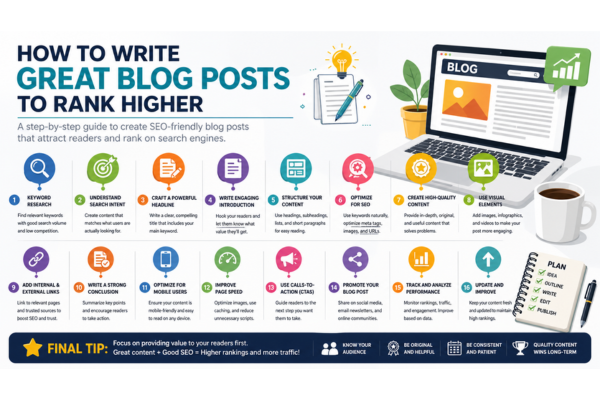
How to Write Great Blog Posts That Rank Higher
Writing a blog post that ranks well requires a balance between SEO strategy and reader-focused content. Below is a step-by-step process to help you create high-performing blog posts.
1. Start with Keyword Research
Every successful blog post begins with keyword research. Keywords are the words and phrases users enter into search engines when looking for information on the internet.
How to do it:
- Identify your topic
- Find relevant keywords with good search volume
- Focus on long-tail keywords (more specific phrases)
- Analyze competitors ranking for those keywords
For example, instead of targeting “blog,” use a more specific phrase like “how to write a blog post for SEO.”
2. Understand Search Intent
Search intent describes the purpose or motivation that drives someone to enter a specific query into a search engine.
If your content matches the user’s intent, it is more likely to rank higher.
There are four main types of intent:
- Informational (learning something)
- Navigational (finding a specific site)
- Transactional (buying something)
- Commercial (research before buying)
Your blog post should align with the intent behind your chosen keyword.
3. Craft a Powerful Headline
Your headline is the first thing readers and search engines notice. A strong title increases click-through rates and improves engagement.
Tips for writing headlines:
- Include your main keyword
- Keep it clear and specific
- Add numbers or power words
- Create curiosity or promise value
Example:
“10 Proven Strategies to Write Blog Posts That Rank on Google”
4. Write an Engaging Introduction
The introduction sets the tone for your blog post. It should hook the reader and explain what they will gain from reading.
A good introduction should:
- Address a problem or question
- Show empathy with the reader
- Clearly state what the post will cover
Avoid long, boring openings. Get straight to the point while keeping it interesting.
5. Structure Your Content for Readability
Well-structured content is easier to read and better for SEO. Use headings and subheadings to break up your text.
Best practices:
- Use H2 and H3 headings
- Keep paragraphs short (2–4 lines)
- Use bullet points and lists
- Highlight key information
Good structure helps both readers and search engines understand your content.
6. Optimize for SEO
To rank higher, your blog post must be optimized for search engines.
On-page SEO tips:
- Include your keyword in the title
- Use the keyword naturally in the content
- Add it to headings where appropriate
- Write a meta description
- Use internal and external links
- Optimize images with alt text
Avoid keyword stuffing. Focus on natural and meaningful usage.
7. Create High-Quality Content
Content quality is the most important ranking factor. Search engines prioritize useful, accurate, and original content.
To improve quality:
- Provide in-depth information
- Use examples and real insights
- Avoid fluff or unnecessary repetition
- Keep your content updated
Aim to create content that truly helps the reader solve a problem.
8. Use Visual Elements
Visuals make your blog post more engaging and easier to understand.
Examples:
- Images
- Infographics
- Charts
- Videos
Visual content can increase time on page and improve user experience, which positively affects rankings.
9. Add Internal and External Links
Linking is essential for SEO.
Internal links:
- Connect to other pages on your website
- Help users navigate your site
- Improve SEO structure
External links:
- Link to credible sources
- Add value and credibility
Make sure all links are relevant and useful.
10. Write a Strong Conclusion
Your conclusion should summarize the key points and encourage the reader to take action.
Include:
- A quick recap
- Final thoughts
- A call-to-action (CTA)
For example:
“Start applying these strategies today to create blog posts that rank higher and attract more traffic.”
11. Optimize for Mobile Users
A large portion of web traffic comes from mobile devices. Your blog post must be mobile-friendly.
Ensure:
- Fast loading speed
- Responsive design
- Easy readability on small screens
Mobile optimization is also a ranking factor in search engines.
12. Improve Page Speed
Page speed directly impacts user experience and SEO.
Ways to improve speed:
- Compress images
- Use a reliable hosting service
- Minimize unnecessary scripts
Faster pages lead to better engagement and lower bounce rates.
13. Use Call-to-Actions (CTAs)
A blog post should guide readers toward a goal.
Examples of CTAs:
- Subscribe to a newsletter
- Download a resource
- Contact your business
- Read another article
CTAs help convert traffic into meaningful results.
14. Promote Your Blog Post
Publishing is just the beginning. Promotion helps your content reach a wider audience.
Promotion strategies:
- Share on social media
- Send via email newsletters
- Engage in online communities
- Repurpose content into videos or graphics
The more visibility your post gets, the better its chances of ranking.
15. Track and Improve Performance
SEO is an ongoing process. You need to monitor your blog post’s performance and make improvements.
Track:
- Traffic
- Rankings
- Bounce rate
- Time on page
Use this data to refine your strategy and update your content.
Common Mistakes to Avoid
Even well-written blog posts can fail if certain mistakes are made.
Avoid:
- Ignoring keyword research
- Writing for search engines instead of people
- Using duplicate or copied content
- Overloading with keywords
- Poor formatting
Focus on delivering value first, and optimization second.
Final Thoughts
A blog post is more than just a piece of writing—it is a strategic tool for attracting, engaging, and converting your audience. When crafted with care and optimized for SEO, blog posts can significantly boost your online presence and help you achieve your goals.
To succeed, focus on understanding your audience, creating valuable content, and applying proven SEO techniques. Consistency is key. The more high-quality blog posts you publish, the stronger your website becomes in search rankings.
Start implementing these strategies today, and you’ll be well on your way to writing blog posts that not only rank higher but also make a lasting impact on your readers.